
Cost, Lifestyle, and Build Differences
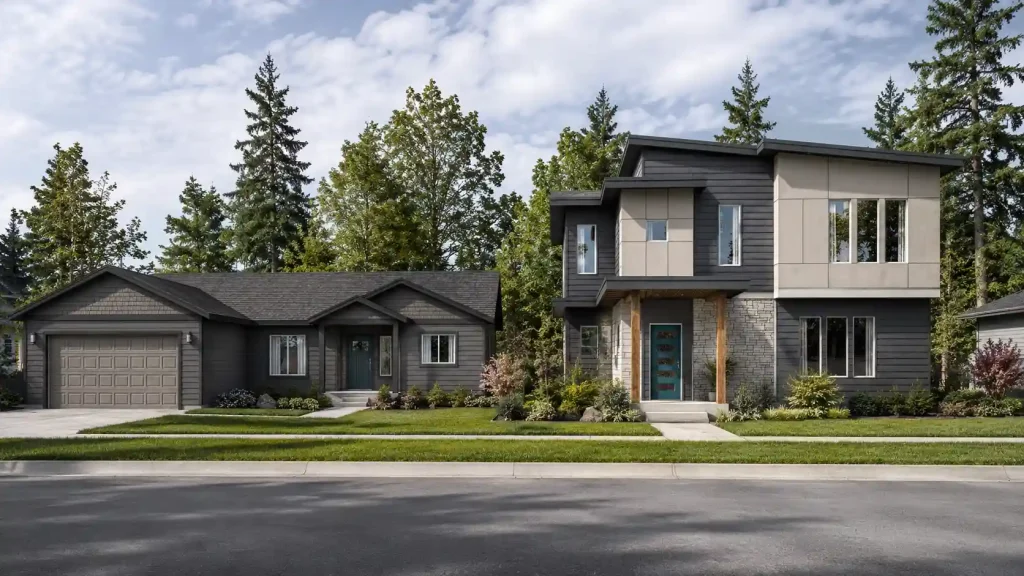
According to AARP’s 2024 Home and Community Preferences Survey, three out of four adults aged 50 and older want to remain in their homes as they age. Yet the way a home is designed determines whether that is actually possible, and the choice between single-story and two-story is one of the earliest decisions that shape it. Whether you go single-story or two-story affects far more than your floor plan.
It can determine how much budget you need, what type of lot you can build on, how complex the build process will be, and how well the home will work for your household for decades to come. If you are building on your land in the Pacific Northwest, understanding these differences before you commit to a design will save you time, money, and second-guessing later.
How Pacific Northwest Lots Shape the Story Decision
One of the most practical differences between the two designs is how much ground they cover, and across the Pacific Northwest, that single factor often drives the decision more than anything else.
A single-story home spreads its square footage horizontally across the lot. On a wide, flat parcel with generous setbacks that works beautifully. But lots in the Pacific Northwest are rarely straightforward. The region is heavily forested, with terrain that shifts quickly, and many rural parcels have steep grades, drainage setbacks, wetland buffers, or irregularly shaped buildable areas.
A single-story home on that kind of land needs more square footage, which can limit what you have left for a garage, outdoor living space, or future additions.
A two-story home stacks its square footage upward, which is why our multi-level home plans work especially well on constrained lots. The same square footage takes up roughly half the ground area. On a hillside lot in the foothills east of Puget Sound, or a narrower rural parcel in the Cascades region, that vertical approach can make the difference between a plan that fits and one that does not.
In other areas, where lots tend to be flatter and more open, single-story builds often have more room to breathe. If you are building on a wide rural parcel in that part of the region, a rambler may fit the land naturally without the footprint trade-offs you would face on a tighter, forested-slope lot.
Cost and What Drives It
The cost relationship between single-story and two-story builds is more nuanced than a simple head-to-head comparison, and Pacific Northwest conditions add real variables that are worth understanding before you choose a plan.
A single-story home needs a larger foundation and roof to provide the same square footage as a two-story home. Across the Pacific Northwest, where annual rainfall is sustained, and roofs are exposed to moss accumulation and wet weather year-round, a larger roof surface area means more material, more maintenance exposure, and more long-term upkeep. That is a real cost consideration over the life of the home, not just at build time.
A two-story home trades that larger foundation and roof for staircase construction, added framing at the floor-to-ceiling transition, and more complex mechanical runs. The Pacific Northwest’s cool, wet winters mean energy efficiency is a real consideration in any build, and a two-story design tends to benefit naturally, as upper floors retain heat more effectively, which can translate into lower heating costs over time.
To put real numbers behind the comparison, our home plans library shows what these differences look like in practice. A single-story plan like the Jasper Park delivers nearly 2,900 square feet with a 72-by-68-foot footprint, starting at $433,900.
A two-story plan like the Clarkston delivers 2,258 square feet on a compact 40-by-35-foot footprint and starts at $357,900. Both are quality builds, but the footprint and starting investment tell a clear story about how each design uses land and budget differently.
The right choice depends on your specific lot, your goals, and the plan that fits both. Our team walks every client through a detailed building process designed to match the right plan to your land and your budget from the start.
Lifestyle Fit: Daily Living in One Story vs. Two
Beyond the build-to-suit math, this decision usually comes down to how you actually want to live in the home over time, and that is worth thinking through carefully before you commit.
Single-story living offers a kind of convenience and accessibility that is genuinely hard to replicate. No stairs to navigate, which matters for young children, aging family members, or anyone who simply does not want to deal with a staircase as they get older. A U.S. Census Bureau analysis found that only about 10% of U.S. homes have the features needed to support aging in place, such as a step-free entrance, a first-floor bedroom, and a full bathroom on the main level.
Building a single story from the start means those features are built in by design, not retrofitted later. For families planning to age in place or accommodate multi-generational living on a single floor, our rambler and ranch-style plans are designed around exactly that kind of long-horizon thinking.
Two-story homes offer a natural separation of spaces that many households find genuinely useful. Sleeping areas upstairs create a real buffer from the activity and noise of the main floor, which works well for families with school-age children or anyone who works from home. Privacy between floors is another real benefit. Guests on the main level are naturally separated from the bedrooms above, making entertaining easier without sacrificing personal space.
A master-on-main layout offers another way to think about two-story living. Our plans, built around this approach, place the primary bedroom on the ground floor so daily living stays stair-free, while guest bedrooms and family spaces upstairs give visitors their own private area. It is a layout that works especially well for households that want the space and separation of two stories without relying on stairs for everyday use.
Building Your Single-Story or Two-Story Home in the Pacific Northwest
True Built Home has been building custom homes on privately owned land across the Pacific Northwest in areas like Washington and Oregon since 2008, and we have seen both layouts work beautifully when matched to the right property and the right family. Whether you are drawn to the accessibility and open flow of a single-story rambler or the space efficiency and separation that a two-story design delivers, our team can help you match the right plan to your land and your goals. Browse our full home plans library to see single-story and multi-level options side by side, and reach out when you are ready to talk through what makes sense for your lot.
What Our Customers Are Saying
“We had a wonderful home built in 2010 that burned to the ground in the Beachie Creek Fire in September 2020. Though we thought we had more than enough homeowner’s insurance, we discovered to rebuild at current costs was outside those funds. We started looking for viable options and discovered True Built Home. Davi and Cameron in the Salem/Keizer local branch saved our hope of rebuilding and made it happen! Davi, as project manager, has been honest and straightforward from the start. He has consistently answered our questions, provided useful advice and led us through the complicated and complex process of decision-making when rebuilding a home. We trust Davi and know for a fact he has our best interests at heart. We could not be more pleased to have him as our project manager and True Built Home as our construction company.”
M. Howser
“We found Davi after working with a few other builder and was surprised at how True Built provided way more upgraded standards which reduced our build by thousands. Davi went above and beyond to meet our fast timeline. Thanks for making our dreams come true.”
K. Johansen
When you are ready to move from research to a real plan, talk to our team about building on your land.