
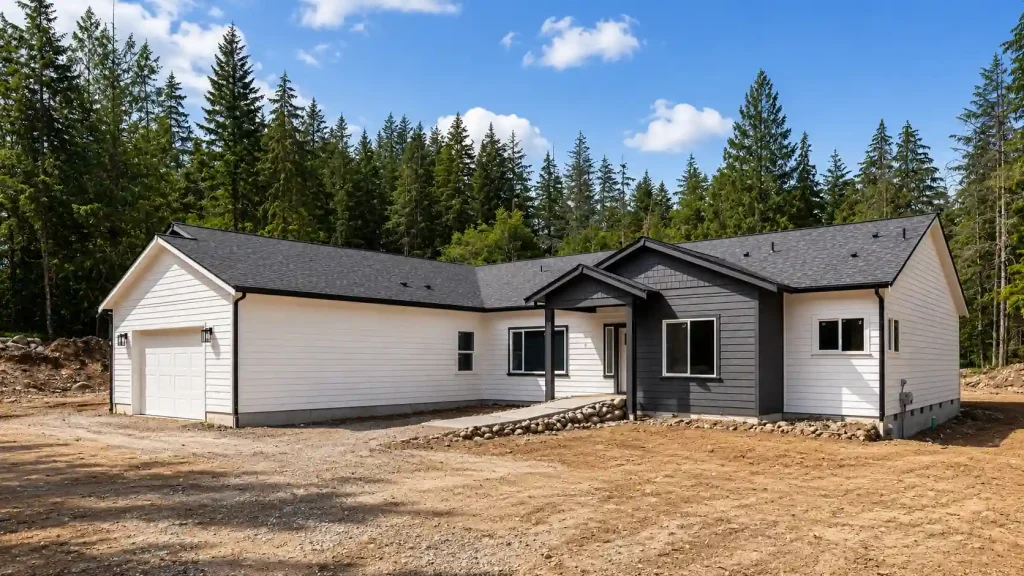
At True Built Home, we hear the same surprise from land buyers again and again: a piece of land being for sale does not mean it is buildable. That distinction trips up more first-time land buyers than almost anything else in the process. It usually comes down to three things nobody thinks to ask about until it is too late: whether the soil can support a septic system, whether the property can actually produce well water, and whether power can reach the house at a reasonable cost. Get any one of these wrong and the rest of your plans- the floor plan, the budget, the timeline, stop mattering.
More than one in five U.S. households depend on individual septic systems for wastewater treatment, according to the EPA. That share climbs sharply in rural areas without access to a municipal sewer line. Most Pacific Northwest land outside city limits falls into exactly that category, which means septic is not an edge case here. It is the default, and it is also the single most common reason a piece of land turns out not to be buildable at all.
Anyone shopping for rural or semi-rural land in Washington or Oregon should assume septic feasibility is a real question worth answering early, not something to figure out after an offer has already been accepted.
Septic: What Your Soil Has to Prove Before You Can Build
Septic approval starts with a perc test, which measures how well water drains through the soil on a specific piece of land. Some soil drains too slowly for a standard system to work, and some drains so fast that it cannot filter wastewater properly before it reaches groundwater. Either result can mean an alternative, more expensive septic design, or in the worst case, no approvable system at all.
A perc test is not optional paperwork. It decides whether a septic-dependent lot can support a home in the first place. We ask for perc test results before finalizing a design on any lot without municipal sewer access, since a floor plan built around a septic system that never gets approved has to be redrawn.
Well Water: What Determines Whether You Can Drill
Well water works on a similar logic but with a different set of variables. Drilling a well does not guarantee it will produce enough water for a household, since yield depends on the aquifer beneath a specific parcel, not just the county it sits in. Two neighboring properties can have completely different well outcomes, one producing a strong, reliable yield and the other coming up short enough to need a deeper well or a backup water source.
Depth matters too, since a well that has to go significantly deeper to reach a reliable aquifer costs meaningfully more than a shallow one, even on lots that are otherwise identical on paper. Water rights add another layer in much of the Pacific Northwest, since some areas require a permit before drilling is even legal, separate from the physical question of whether water is actually down there.
Checking well feasibility before a homeowner commits to a specific lot is standard practice on our end, not an afterthought handled once a purchase has already closed.
Power: Why “Close to the Road” Doesn’t Mean Connected
Power is the utility most buyers assume is settled simply because a road runs past the property. Being near a road and being connected to the grid are not the same thing, and the gap between the two only shows up once someone actually asks the utility company how far the nearest line runs.
Extending power lines to a lot that sits any real distance from existing infrastructure can cost tens of thousands of dollars, and in most cases that cost falls on the buyer, not the utility company. A lot that looks perfectly buildable on paper can become a budget problem the moment someone calls the utility for a quote. Getting a real power extension estimate early is part of how we help a client avoid discovering this cost after a design is already finished.
Why All Three Have to Clear Before You Finalize a Plan
None of these three utilities exists in isolation, and a plan that clears two out of three is not actually a plan, no matter how good the other two results look on their own. A lot with excellent soil and a strong well but no realistic path to power is not buildable yet. A lot with power at the property line but soil that fails every perc test is not buildable either.
All three have to clear before a floor plan gets finalized to fit the actual site; a budget or a timeline means anything real, which is exactly why these questions belong at the very start of the process rather than somewhere in the middle. We treat all three as a single go-or-no-go decision rather than three separate checkboxes, since a lot that fails on any one of them is not buildable regardless of how the other two turn out.
How a Feasibility Study Answers These Questions Before You Buy
This is precisely what a feasibility study is built to answer before a homeowner commits to land or a plan. Our team works through septic suitability, well feasibility, and power access as part of the same site assessment, alongside the topography, drainage, and zoning review that shapes everything else about a build.
A feasibility study will not make a difficult lot easy, but it replaces guessing about septic, well, and power with a real answer before you spend money and months on a plan the land cannot support. Finding out a lot fails on one of these three utilities before purchase is disappointing. Finding out after closing is expensive.
Why Our Experience With Rural and Off-Grid Land Matters
True Built Home has built on-your-lot custom homes throughout Washington and Western Oregon since 2008, and a meaningful share of that work happens on land that never had municipal utilities to begin with.
That experience means we know what a passing perc test actually looks like in Pacific Northwest soil, what a realistic well yield looks like for a given region, and roughly what power extension costs tend to run before a homeowner gets a formal quote. None of that replaces a real site-specific study, but it means the conversation starts from experience rather than a guess, and it carries straight into how we approach the rest of the building process once a lot actually clears.
Ready to Find Out What Your Land Can Actually Support?
If you already own land, or you are close to purchasing a piece that hasn’t been tested for septic, well, or power access, the smartest move is to find out what your specific property can support before you fall in love with a floor plan you may not be able to build. Reach out to talk through your land, and we will help you understand what these three utilities actually mean for your site before you commit to anything else.