
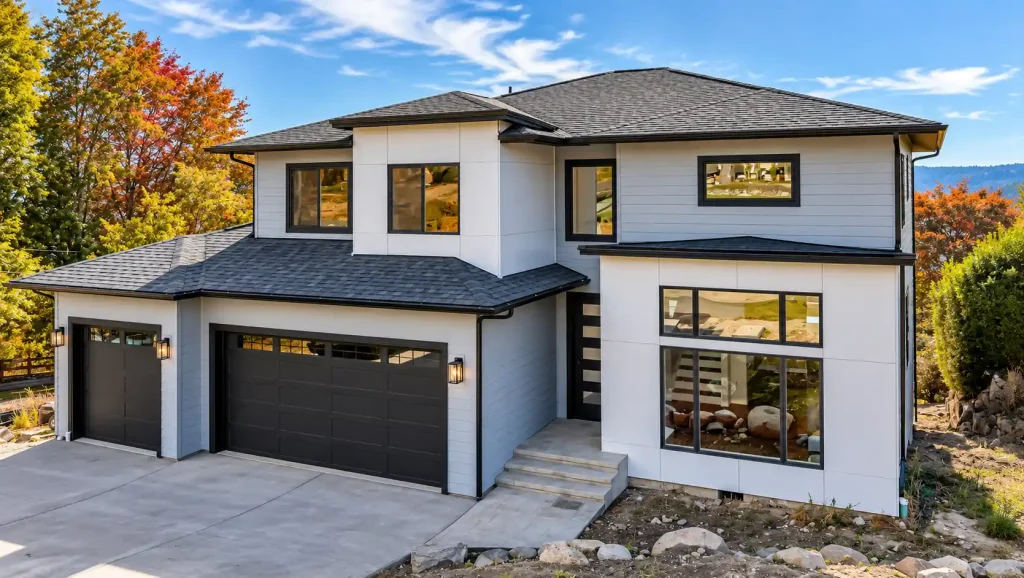
Not every new home starts from the same blank page. Some start from a builder’s existing catalog, finished down to the cabinet pulls before a buyer ever signs anything. Others start with the lot, the budget, and a long conversation about what matters most to the people who will live there.
That second category is bigger than most buyers realize. In 2025, builders started 131,000 contractor-built single-family homes, the category that covers true custom construction built for a specific owner, at a median contract price of $404,000, the U.S. Census Bureau reports in its most recent housing characteristics data. Custom building is not a rare, premium exception. It is a well-established path, and understanding how it differs from a production home makes the decision much easier.
What Actually Separates a Custom Home from a Production Home
A production home is built from a set menu. A builder selects a handful of floor plans, builds many of them across a development, and offers buyers a short list of finish packages to choose between. The efficiency comes from repetition: the same plan, built repeatedly, with predictable costs and timelines.
A custom home starts from a different premise entirely. You decide the floor plan, room sizes, finishes, and often the lot itself, one project at a time, around one household’s actual priorities. Nothing about it is mass-produced, which is also why it takes more coordination and more time than picking a plan off a shelf.
That coordination starts earlier than most buyers expect. Before we ever treat a custom lot as buildable, we suggest working with a feasibility company to determine what can be built, and we confirm the utilities and water or sewer access a household will actually depend on, rather than assuming a piece of land is ready just because it is listed for sale. A production home skips that step entirely, since the builder already cleared the development’s land years before a single buyer walked through a model home.
Neither approach is automatically better. A production home can be a smart, efficient fit for a buyer whose priorities match what is already on offer. A custom home earns its added complexity when standard options genuinely don’t fit how a household lives.
Where Customizable Plans Fit Into the Decision
Customization is not all-or-nothing. Some production builders allow light customization within a fixed plan. We work differently: most of our homes start with a proven base plan that we adjust to fit what matters most to a household, which is where much of the confusion comes from when people compare custom and production homes.
The real question isn’t whether customization is available, but how far it actually goes within that base plan. Swapping a countertop finish is customization in name only if the floor plan, room layout, and structural choices are already locked in. The adjustments that matter most are the hardest to undo later: how a base plan’s layout shifts to fit a household’s routines, and which rooms get finished now versus left as an afterthought.
That is also where the open floor plan versus defined room debate actually belongs. A production plan locks that decision in before a buyer is even involved. Our customizable home plans let a household decide for itself based on how it actually uses a home, rather than how a plan was drawn for the broadest possible buyer. We capture that in conversations with clients before design even starts, along with lot details and the county the home will sit in, so we treat it as real design input rather than a change request added after the floor plan is set. Most homeowners build with us this way, adjusting a proven plan around how they actually live. When a project genuinely calls for something built from the ground up, we take those on as well, though that is the exception rather than the typical path.
Is the Added Cost and Time Worth It?
Cost is where the comparison gets most direct. A custom home generally costs more than a comparable production home, and it is fair to ask what that difference actually buys.
What a builder includes in a base price varies enormously, and a production home’s lower starting price often reflects fewer included upgrades and lower-tier fixtures and finishes. A custom build folds more decisions, more standard-included features, and higher-quality fixtures and finishes into the base price from the start. Other builders treat triple-pane windows, quartz countertops, or a modular smart-switch package as an upgrade; but we build them into every home’s base price from the start.
Financing adds another layer most comparisons skip. A production home’s financing is usually a standard mortgage against a finished or nearly finished house. A custom build often needs a construction loan that converts once the home is complete, and not every lender handles that conversion smoothly. We steer homeowners toward a short list of recommended lenders familiar with that process, several of whom we’ve worked with for years, so we settle the financing early rather than treating it as an afterthought once the design is locked.
Timeline follows a similar logic. A custom build on your own land typically takes longer than a production home in an existing development, largely because of the site work, individual permitting, and design decisions a production home skips by repeating an already-approved plan.
What You Actually Get to Change in Each Approach
The clearest way to separate the two is to look at what stays fixed versus what moves.
In a production home, the floor plan and structural systems are fixed, and choices usually stop at finishes, colors, and a short list of optional upgrades, which can make most of those homes feel cookie-cutter. In a custom home, the floor plan starts with a proven base plan that gets adjusted to fit the household, rather than a layout fixed before the homeowner is even involved, and that extends to the systems behind the walls.
Decisions like dedicated circuits, network wiring, and built-in lighting must be made during design, not chosen from a list after the fact, because a custom build is designed around a household’s actual plans, not a generic one. A homeowner working with us can see each decision logged and tracked through our online project portal as the build moves forward, instead of hoping a verbal change request gets passed along correctly between trades.
Building Custom, On-Your-Lot Homes Across Washington and Oregon
For close to two decades, True Built Home has built on land a homeowner already owns, rather than steering them toward a development lot picked out in advance. Customization in that model is not a premium tier layered on top of a standard plan. It is a customized plan, shaped around the household building it from the first design conversation onward.
That shows up in how a project actually runs. The process starts with a Home Sales Consultant, then moves to our in-house design team to shape the plan around the household, before a pre-construction meeting hands the build over to a Project Manager, who oversees it through production. One platform carries that communication through the whole process, so other team members, whether it’s a financing question or a site-specific detail, step in exactly when needed, rather than a homeowner being passed between departments for every question. The standard-included features and oversight don’t change based on how much a homeowner customizes. A heavily customized home gets the same attention as a straightforward one.
Which Approach Actually Fits What You Want to Build?
The right answer depends less on budget alone and more on how much of the decision you want to make yourself.
If a short list of finish choices sounds like enough, a production home may serve you well. If you want the floor plan, systems, and finishes shaped around your priorities rather than picked from a fixed list, get in touch, and a home consultant will map out what that could look like on your lot.